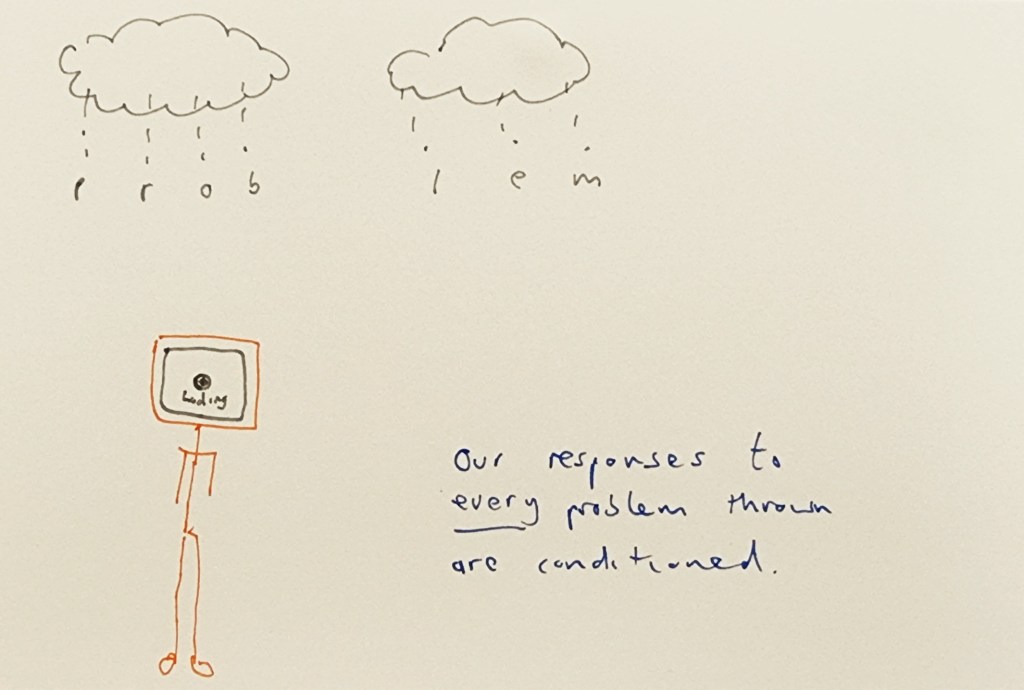
How do we human beings usually do and don’t? How are we educated to tackle problems today?
Instantly accessible web pages, videos, how to deal with this, how to think about that, rules for this, commandments for that, diagnoses, treatments – as if all I have to do is pick the right ones that make sense to my developing, maturing body with organs. How would we know what the ‘right ones’ were, are, will be? Isn’t it that we see many problems thrown at us as if they were technical? If the device in my hand, used as a manual for living distracts me from learning how I learn, then in our children’s hands with their brains developing how to do and don’t do things via instruction, via other’s thoughts and ideas most, if not all the time, then what quality of mind are we developing in our children? It may be the quality of mind that has built the kind of media presentation of the world that we are subjected to today. It may be the quality of mind that we see in the egomaniacs that have reached obscene levels of wealth, narcissistic power and control and are structuring our experiences at home, leisure and at work for us all.
Is it that to deal with all challenges and problems we look to experts? Examine Statistics? Each and every challenge we will face is not always a technical challenge. I’d call a flat tyre on my bike a technical challenge. To meet the challenge is to find the puncture, what may have caused the hole, and with tools, repair or replace the inner tube, inflate and continue on riding. If I sat there and started to think how unlucky I was, how awful that it is that I have a puncture, continuing such a train of thought leads only to despair and paralysis for actually meeting the challenge – then the challenge becomes a problem.
If I feel flat, so to speak, in a low mood, is there an equivalent puncture repair kit for my body and mind? We approach it as if there is! If the flat tyre problem is a rather simple challenge, a low mood in myself may or may not be simple, it may well have complexities unbeknownst to me. I can feel anxious and not know what it is, unable to articulate except in feelings and body language – I can’t find the words yet, and it’s possible I won’t ever. This is to be distinguished from when I worry because worrying is always about something identifiable that I can describe. Feeling anxious and not knowing, thought can come in looking for the worrying verbs, the situation and it can use anything to confirm that there is danger.
I can go online, search up ways to lift me out of a low mood and I will be presented with remedies, pastimes and activities that others swear by and/or endorse that helped in lifting their mood. Let me be clear in that I am not saying that these remedies and rules are in themselves wrong and should not be lived. I am majorly concerned that our children are seeing these remedies as an antidote to their mild discomfort or even ‘poisonous’ painful feelings. Living everyday then becomes about experiencing pleasure and avoiding pain and an efficient way to do this is to take pleasure-seeking-pain-avoiding-actions piece by piece, to build walls with them, shape their life with, shape their brains with, structure their thinking with, and come to identify themselves in specific ways. A kind of building of an individualistic personal egoic sense of justice. There are of course many of their peers doing the same and they share many common ‘treatments’ which is used as compatibility currency of friendship or it’s opposite to divide others into outcasts or enemies. I am fearful that in approaching uncomfortable and unidentifiable feelings within, fearful feelings, our children will overlook how it is they are seeing the world right now. The absorbing gaze towards those that seem to have no problems at all or indeed express their feelings and communicate what they think works for them, is hypnotic to our child to merely imitate. I suspect sometimes that this seems to help, while sometimes it just serves to make the child more anxious because their uneasy feelings return even though the TikTok star says it works for them. Thought often says ‘It doesn’t work for me so there’s something wrong with me.’ Our youth in particular are developing a kind of technical coping strategy to the messy busy world, and they are learning that from us as we do not emphasise the kind of learning that has nothing to do with ideation. They are learning specific and particular relationships to combat certain issues of the time based on nothing but trends and fashions and current thinking which is severely limited and compromised by profiteering. Much of the knowledge available to us (see The Repository of Knowledge post) I see that the stuff that they are being presented with, the content and the mental processing of that content is treated like a simple technical problem.
A flat tyre is a very short lived problem if a problem at all. A flat human can’t as such technically be repaired and maybe just maybe the way we think about our problems and challenges is the deflator of our selfs [sic.].
 An Education of Understanding